




Hydrogen Purity Measurement Ensures Safe and Efficient Operation of Hydrogen-Cooled Generators
Problem
Hydrogen is used as the cooling medium in large electricity generators due to its high thermal conductivity and low viscosity, which prevents efficiency losses from increased drag or windage on the rotor. The high rotational speed of large diameter rotors generates heat, so the rotor side of the generator set requires high rates of cooling at low drag for efficiency. The hydrogen is pumped from the generator into a closed drier and cooling system before re-entering the generator. Contamination with air must be avoided to mitigate the risk of explosion, prevent early failure of mechanical components, and reduce inefficiency. A reduction in hydrogen purity from 97% to 95%, for example, can increase windage losses by as much as 32%. Removing oxygen also reduces the potential for damage to the winding insulation caused by corona discharges.
Application
| Regular operation | 80% – 100% H₂ in air |
|---|---|
| Purging | 0% – 100% air in CO₂ |
| Scavenging | 0% – 100% CO₂ in H₂ |

Benefits:
- Highly robust analyzer capable of measuring all required ranges, with high reliability driven by having no moving parts and proven industry references
- Turnkey solution with full sample handling capabilities
- Simple field calibration
Challenge
The challenge for the customer is to ensure that their closed-loop hydrogen system has an accurate and reliable measurement of hydrogen purity so that the safety and efficiency of the generator set is maintained. While customers typically measure hydrogen leaks to atmosphere outside the generator with ambient monitors, the primary measurement is on the purity within the closed-loop system. During regular maintenance intervals, there is also a requirement to enter the generator housing and vent it to atmosphere. To avoid the risk of explosion from mixing hydrogen with air, a scavenging system is used to first displace the hydrogen with an inert gas such as CO₂. Only when measurement confirms that the hydrogen has been displaced is the CO₂ in turn displaced with air, and only once measurement confirms that air is present can maintenance be safely carried out.
Solution
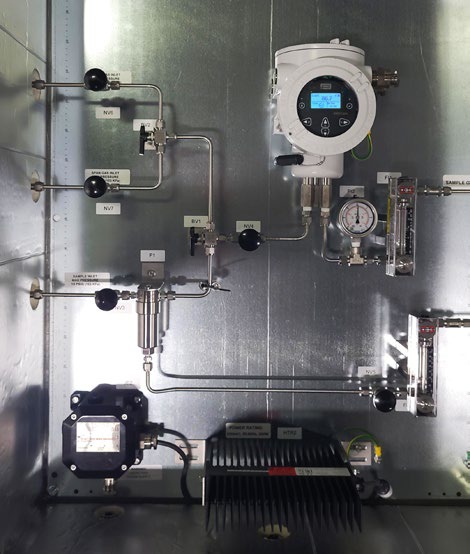
The Panametrics XMTCpro thermal conductivity analyzer is perfect for this application. This solution has the added advantage of being able to measure the two other gas ranges during start-up purging and shut-down scavenging. During start-up, the XMTCpro is set to measure air in CO₂. When the analyzer confirms a full CO₂ atmosphere, hydrogen is introduced and the XMTCpro is set to measure H₂ in CO₂. Once full displacement has been achieved, the analyzer is set to measure air in hydrogen. For shut-down, the process is reversed, and the XMTCpro analyzer again measures and confirms the scavenging of the relevant gases.
Source: Panametrics Application Note PANA051AN (panametrics.com) — © Panametrics LLC. Localized and prepared by INTECH CONTROL, the official Panametrics representative in Slovakia and Hungary.